
AI Smart Lighting: What Buyers Need to Know in 2026

September 2026 | Lighting Industry News
AI smart lighting is changing the lighting industry in 2026.
AI is becoming part of modern smart lighting systems. It can help lights respond to users, room conditions, and daily activities.
Recent product launches also show this trend. Leading smart lighting brands are adding AI features to their products. These features include smart control, lighting automation, and natural language commands.
But what does this mean for lighting buyers?
For distributors, contractors, and project buyers, the key question is simple:
Does AI bring real value to a lighting project?
In this article, we look at the latest AI smart lighting trends. We also explain what buyers should check before choosing a smart lighting solution.
AI Is Bringing New Ideas to Smart Lighting
Smart lighting is not new. Many systems already support apps, sensors, timers, and remote control.
AI adds a new layer to these systems.
A smart light can follow a set rule. An AI-based system can also use data to make better choices.
For example, a lighting system may consider:
- Time of day
- Room use
- User preferences
- Occupancy
- Natural light
- Lighting schedules
The system can then adjust the lighting based on these inputs.
This can make lighting easier to use. It can also reduce the need for manual control.
Recent products show this trend. At IFA 2026, several smart lighting brands introduced new AI features. These included AI-based lighting control, smart automation, and better device connections.
What Can AI Do for Lighting?
AI can support many lighting tasks.
1. Automatic brightness control
AI can help adjust brightness based on room use.
For example, a meeting room may need more light during a meeting. It may need less light when the room is empty.
This can improve comfort and reduce wasted energy.
2. Lighting scene control
Users can create different lighting scenes for different needs.
For example:
- Work
- Meeting
- Reading
- Relaxing
- Presentation
- Evening
AI can make scene control easier. Users may not need to set every light by hand.
3. Smart scheduling
Lighting systems can also use time and usage data.
For example, lights can turn on before a workday starts. They can dim during low-use periods. They can also turn off when a space is empty.
These simple actions can help reduce energy use.
4. Better user control
AI can make smart lighting easier for non-technical users.
Instead of opening an app and changing several settings, a user may give a simple voice command.
This can make smart lighting more useful in homes, offices, hotels, and other spaces.
AI Does Not Mean Better Lighting by Itself
This is an important point for lighting buyers.
A product is not automatically better because it uses AI.
The basic lighting performance still matters.
Buyers should first look at the quality of the complete luminaire.
Key factors include:
- Luminaire efficacy
- Light output
- CRI
- Color temperature
- Glare control
- Flicker
- Driver quality
- Thermal design
- Product lifetime
For example, a high lm/W figure is useful. But it does not tell the whole story.
A good lighting product must also provide the right light for the application.
The U.S. Department of Energy also evaluates commercial LED luminaires based on factors such as light output, efficacy, and application needs.
Energy Efficiency Is Still a Key Buying Factor
Many buyers are interested in AI because they want smarter energy use.
However, AI itself does not save energy.
The savings come from better control.
For example, a lighting system can reduce output when a room is empty. It can also dim lights when there is enough daylight.
Occupancy sensors, daylight control, schedules, and dimming can all help reduce energy use.
This means buyers should ask a simple question:
What does the smart system actually control?
Does it control:
- Brightness?
- Color temperature?
- Occupancy?
- Lighting schedules?
- Daylight response?
- Energy use?
The answer matters more than the word AI on the product package.
Smart Lighting Needs Good Connectivity
AI is only one part of a smart lighting system.
Connectivity is also important.
Different lighting systems use different communication methods. These may include:
- DALI
- DALI-2
- 0–10V
- DMX
- Zigbee
- Bluetooth
- Wi-Fi
- Thread
- Matter
Each option has different uses.
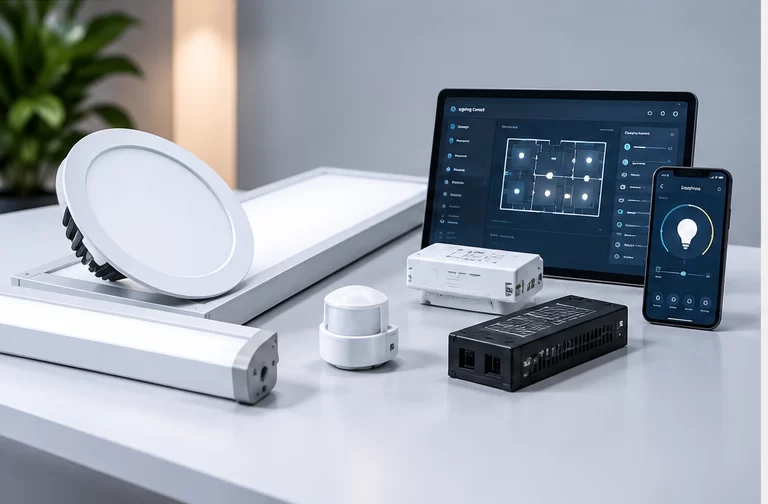
For example, a commercial project may need DALI for lighting control. A smart home may use Matter, Thread, Wi-Fi, or other wireless systems.
Buyers should check system compatibility before placing an order.
Why Matter Matters for Smart Lighting
Interoperability is becoming more important.
Many buyers do not want a lighting system that only works with one brand.
Matter is designed to help smart devices work across different platforms.
This can make smart lighting easier to manage.
At IFA 2026, Aqara introduced new lighting products with Matter and Thread support. The products can connect with several major smart home platforms.
For buyers, this means one thing:
Check compatibility before you buy.
A smart light may have many features. But those features have little value if the product cannot work with the system used in your project.
What Should Lighting Buyers Check in 2026?
AI can make lighting smarter. But buyers still need to check the basics.
Here is a simple checklist.
Lighting performance
Check:
- Lumens
- lm/W
- CRI
- CCT
- Beam angle
- Glare
- Flicker
Product quality
Check:
- LED brand
- Driver quality
- Heat management
- Lifetime
- Operating temperature
- Warranty
Control options
Check:
- Dimming
- Sensors
- DALI
- 0–10V
- Wireless control
- Smart home support
System compatibility
Check:
- Matter
- Thread
- Zigbee
- Bluetooth
- Wi-Fi
- Existing control systems
Project needs
Also check:
- Installation
- Local standards
- Certifications
- Maintenance
- Spare parts
- After-sales support
This approach can help buyers avoid choosing a product based only on new technology.
AI Is More Useful When It Solves a Real Problem
AI should have a clear purpose.
For example, a hotel may want better room control.
An office may want lower energy use.
A retail store may want flexible lighting scenes.
A smart home user may want easier control.
These are real needs.
The best smart lighting solution is not the one with the most features.
It is the one that solves the right problem.
What Does AI Mean for Lighting Manufacturers?
The growth of AI is also changing the work of lighting manufacturers.
Lighting products now need to work as part of a larger system.
Manufacturers may need to support:
- Smart controls
- Sensors
- Dimming
- Tunable white
- Wireless systems
- Matter
- DALI
- Project customization
At the same time, basic product quality cannot be ignored.
A smart function cannot fix poor light output.
AI cannot replace a poor driver.
A smart control system cannot solve poor thermal design.
This is why lighting manufacturers still need strong product design and testing.
The Future of Smart Lighting
The lighting industry is moving from simple LED products to connected lighting systems.
The next step is more adaptive lighting.
AI may help lighting systems understand users and spaces. It may also make control easier.
But AI is not the whole story.
Good lighting still needs:
Efficient LEDs + good optics + reliable drivers + good thermal design + smart controls
When these parts work together, lighting can become more efficient, flexible, and easier to manage.
Jinbiao Lighting’s View
AI is changing smart lighting in 2026.
It can improve control, automation, and user experience.
But buyers should not choose a product only because it has AI features.
Look at the complete lighting solution.
Check its efficiency, light quality, driver, controls, connectivity, and reliability.
Most importantly, ask:
What problem does this technology solve?
That is the best way to choose smart lighting for a real project.
About Jinbiao Lighting
Jinbiao Lighting is a professional LED lighting manufacturer serving customers in global markets.
We focus on reliable lighting products and practical solutions for different applications.
Our approach is simple:
Good lighting starts with good products.
Smart technology can add more value, but quality always comes first.