
How Can Lighting Controls Reduce HVAC Energy Use?

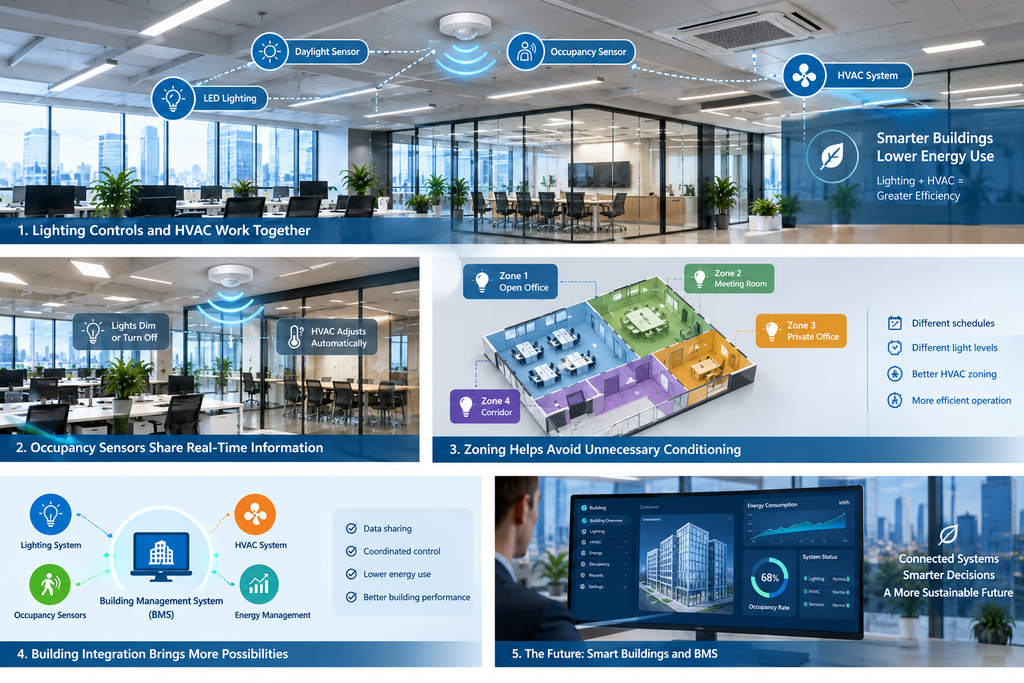
Lighting and HVAC are two important systems in commercial buildings. Traditionally, they operate separately. However, connected building systems are changing this approach.
Lighting controls and HVAC can work together to respond to occupancy, schedules, and changing building conditions.
For example, an occupancy sensor can detect when a meeting room is empty. The lighting system can dim or turn off the lights. At the same time, connected HVAC controls can adjust the temperature or place the zone into an occupied-standby mode.
This approach can reduce unnecessary energy use.
In 2026, the DesignLights Consortium (DLC) updated its Networked Lighting Controls requirements to recognize emerging opportunities for lighting-to-HVAC integration. The new NLC V5.2 requirements took effect on August 17, 2026.
So, how exactly can lighting controls help reduce HVAC energy use?
What Is the Connection Between Lighting and HVAC?
Lighting produces heat.
Even efficient LED lights convert part of their electrical energy into heat. In a conditioned space, the cooling system may need to remove some of this heat.
This creates a simple connection:
Lighting energy → Heat inside the building → Cooling demand
When a building reduces unnecessary lighting operation, it can also reduce the heat added to the space.
However, this does not mean every lighting upgrade will create a large HVAC saving. The actual impact depends on the building, climate, lighting load, operating hours, and HVAC system.
The bigger opportunity comes when lighting controls also provide useful occupancy data to HVAC controls.
How Can Lighting Controls Reduce HVAC Energy Use?
There are several ways that connected lighting systems can support HVAC energy management.
1. Occupancy Sensors Share Real-Time Information
Occupancy sensing is one of the most useful links between lighting and HVAC.
A sensor can detect whether people are using a room or zone.
If a space becomes empty, the lighting system can reduce the light level. With the right integration, the same occupancy information can also be sent to the HVAC system.
The HVAC system can then adjust its operation for the unoccupied space.
For example:
Room occupied → Normal lighting + normal HVAC
Room empty → Reduced lighting + reduced HVAC operation
This approach avoids conditioning empty spaces at the same level as occupied spaces.
The DLC notes that occupancy data from networked lighting control sensors can be used by compatible thermostats to place HVAC zones into occupied-standby modes.
2. Lighting Controls Can Support Smart Thermostats
Smart thermostats can use more information than a traditional temperature sensor.
When a lighting control system provides occupancy information, a compatible thermostat can respond to actual space use.
For example, consider a small meeting room.
The room may have a fixed schedule from 9:00 a.m. to 5:00 p.m. However, the room may remain empty for several hours.
A lighting sensor can detect the real occupancy condition.
If the systems are properly integrated, the thermostat can adjust the HVAC operation during those unoccupied periods.
This can be useful in:
- Offices
- Schools
- Retail stores
- Meeting rooms
- Small commercial buildings
- Shared workspaces
The DLC’s 2026 NLC guidance specifically recognizes thermostat integration as an external system integration capability.
3. Zoning Helps Avoid Unnecessary Conditioning
Large buildings usually contain different zones.
For example, an office may have:
- Open work areas
- Meeting rooms
- Storage rooms
- Corridors
- Reception areas
- Break rooms
These areas do not always have the same occupancy pattern.
A networked lighting control system can divide the building into lighting zones. With suitable building integration, occupancy information can also support HVAC zoning.
This allows the building to respond to actual use.
An empty storage room does not always need the same operating conditions as a busy office.
Better zoning can therefore help reduce unnecessary heating and cooling.
4. Scheduling Can Coordinate Lighting and HVAC
Scheduling is another useful strategy.
Many commercial buildings have predictable operating hours.
For example:
- Office: 8:00 a.m. to 6:00 p.m.
- Retail store: 9:00 a.m. to 9:00 p.m.
- Warehouse: 7:00 a.m. to 7:00 p.m.
Lighting controls can follow these schedules.
HVAC systems can also use similar schedules.
When both systems are coordinated, the building can reduce unnecessary operation outside occupied hours.
However, schedules should remain flexible.
Real buildings do not always follow the same pattern every day. Sensors and manual overrides can help deal with changes.
5. Daylight Controls Can Reduce Lighting Heat
Daylight harvesting is another lighting control strategy.
A daylight sensor measures the amount of natural light in a space.
When enough daylight is available, the lighting system can reduce LED output.
For example:
More daylight → Lower LED output
Less daylight → Higher LED output
This reduces lighting energy use.
It can also reduce the amount of heat produced by the lighting system.
The HVAC impact may be more noticeable in buildings with high cooling loads and significant lighting operation.
Again, the actual result depends on the building and local conditions.
6. LED Controls Can Reduce Cooling Load
Lighting controls can reduce the time that LED fixtures operate at high output.
This matters because every watt used by lighting eventually contributes to the building’s internal heat load.
Consider a commercial office with hundreds of LED fixtures.
If all fixtures operate at full output throughout the day, the lighting system produces a relatively constant heat load.
If controls reduce output during periods of low occupancy or high daylight, the lighting load falls.
The cooling system may then have less heat to remove.
This creates two possible energy benefits:
Lighting control → Lower lighting energy
Lower lighting load → Potentially lower cooling demand
The second effect is usually more dependent on the building design than the first.
7. Networked Lighting Controls Can Connect Building Systems
This is where the concept becomes more powerful.
Traditional lighting controls usually focus on lighting.
Networked lighting controls can communicate with other systems.
These may include:
- HVAC
- Building automation systems
- Smart thermostats
- Energy management systems
- Sensors
- Building management software
The DLC describes networked lighting controls as a potential foundation for integrated building controls. Its 2026 NLC V5.2 update specifically adds recognition for NLC-HVAC integration.
This means lighting can become more than a standalone electrical system.
It can also provide useful information for building operation.
How Much HVAC Energy Can Lighting Controls Save?
There is no single savings percentage that applies to every building.
The result depends on:
- Building type
- Climate
- Lighting power
- HVAC efficiency
- Occupancy pattern
- Operating schedule
- Sensor placement
- Control strategy
- System integration
- Commissioning quality
Recent industry information provides some useful examples.
An Inside Lighting analysis of the DLC’s 2026 NLC update reported early results from the Northwest Energy Efficiency Alliance suggesting that occupancy data from luminaire-level networked lighting controls could save up to 11% of cooling energy and up to 21% of heating energy in a well-maintained building. These figures are reported early results, not universal savings guarantees.
The same source also reports that the DLC sees HVAC integration as a way to extend energy savings beyond lighting itself.
Therefore, project owners should use building-specific calculations instead of applying a fixed percentage.
What Are the Main Benefits of Lighting Controls and HVAC Integration?
When designed correctly, integrated controls can provide several benefits.
Lower Energy Use
Lighting controls reduce unnecessary lighting operation.
HVAC integration can reduce unnecessary heating and cooling in unoccupied areas.
Better Building Operation
The system can respond to actual occupancy instead of relying only on fixed schedules.
Better Space Management
Facility managers can understand how different areas are used.
More Flexible Control
Users can adjust zones, schedules, and lighting levels as building needs change.
Better Data
Networked systems can provide information about lighting operation and, depending on the system, energy use and occupancy.
Support for Energy Efficiency Programs
Some energy efficiency programs now place more emphasis on networked lighting controls.
The DLC reported that its NLC V5.2 requirements are designed to support efficiency programs, manufacturers, distributors, contractors, specifiers, and building owners.
Which Buildings Can Benefit From Lighting Controls and HVAC Integration?
This approach can work across many commercial applications.
Offices
Offices often have changing occupancy levels.
Meeting rooms may remain empty for long periods. Occupancy-based control can help reduce unnecessary lighting and HVAC operation.
Schools
Classrooms can have very different schedules.
A room may be unused during holidays, lunch breaks, or between classes.
Connected controls can help building systems respond to these changes.
Retail Stores
Retail spaces often have fixed opening hours.
However, storage rooms, offices, and other back-of-house areas may have lower occupancy.
These areas can benefit from occupancy-based control.
Warehouses
Warehouses often contain large zones.
Some aisles may remain empty for long periods.
Lighting controls can reduce lighting output in unused areas. Integrated systems may also use occupancy information for HVAC control where appropriate.
Hotels
Hotels contain many different spaces.
Guest rooms, meeting rooms, corridors, restaurants, and service areas all have different occupancy patterns.
Connected controls can help manage these zones more efficiently.
What Role Do Occupancy Sensors Play?
Occupancy sensors are an important part of the system.
Common sensor technologies include:
- PIR sensors
- Microwave sensors
- Ultrasonic sensors
- Multisensor devices
The right sensor depends on the application.
For example, a sensor for an open office may need different coverage from a sensor for a small meeting room.
Sensor placement also matters.
A poorly positioned sensor can provide inaccurate occupancy information.
Therefore, suppliers and installers should consider:
- Detection range
- Mounting height
- Room size
- Furniture
- Movement patterns
- False detection
- Communication range
Good sensor performance is essential for reliable automation.
What Should Buyers Check Before Choosing an Integrated System?
If you are sourcing LED lighting for a commercial project, do not only check the LED fixture.
Also check the control system.
Check LED Driver Compatibility
The LED driver should work correctly with the selected control system.
Check:
- Dimming range
- Dimming method
- Driver protocol
- Flicker performance
- Minimum dimming level
Check Sensor Compatibility
Confirm that the lighting system supports the required occupancy and daylight sensors.
Check HVAC Integration
Ask whether the system can communicate with:
- Smart thermostats
- HVAC controllers
- Building automation systems
- BACnet systems
- Other supported platforms
Check Communication Protocols
Different projects may use different communication technologies.
These can include:
- DALI
- DALI-2
- DALI+
- Bluetooth
- Ethernet
- BACnet
- Other network technologies
Compatibility should be confirmed before purchasing.
Check Cybersecurity
Connected lighting systems can become part of a building network.
Therefore, cybersecurity should be considered during product selection and system design.
The DLC’s NLC V5.2 requirements include cybersecurity among the required indoor system capabilities for qualified NLC systems.
Check Commissioning and Support
A good control system still needs proper installation and commissioning.
Ask the supplier about:
- Installation guidance
- System configuration
- Sensor setup
- Software training
- Troubleshooting
- Warranty
- Technical support
Can Lighting Controls Reduce HVAC Energy in Retrofit Projects?
Yes, but the result depends on the existing building.
A typical retrofit may replace old fluorescent fixtures with LED products.
The project can also add:
- Occupancy sensors
- Daylight sensors
- Networked controls
- Smart thermostats
- Zone control
This creates an opportunity to improve both lighting and HVAC operation.
Wireless controls may also be useful when adding new control functions to an existing building.
However, the installer should first check the existing electrical system, HVAC system, network, and building structure.
Lighting Controls vs. HVAC: Why Integration Matters
Lighting and HVAC have traditionally been designed as separate systems.
That approach can work.
However, connected buildings create opportunities for better coordination.
Lighting systems already use sensors.
Those sensors can provide valuable information about occupancy and space use.
Instead of installing separate sensors for every building system, an integrated approach can allow compatible systems to share information.
The goal is not to make the system more complicated.
The goal is to use available information more effectively.
Lighting Controls and HVAC Integration Checklist
Before starting a commercial LED project, buyers can use this checklist:
- Does the LED driver support the selected controls?
- Does the system support occupancy sensing?
- Can occupancy data be shared with HVAC controls?
- Does the system support daylight harvesting?
- Can lighting and HVAC schedules work together?
- Can the building be divided into zones?
- Does the system support smart thermostats?
- Can it integrate with the existing building management system?
- Which communication protocols are supported?
- Is cybersecurity included?
- Can the system provide energy data?
- Is commissioning support available?
- Can the system be expanded later?
- What warranty and technical support are included?
A clear checklist can reduce compatibility problems before installation.
The Future of Lighting and HVAC Integration
Commercial lighting is moving beyond simple on/off control.
Modern LED systems can combine:
- High-efficiency LED fixtures
- Sensors
- Dimming
- Network communication
- Energy monitoring
- Smart thermostats
- Building management systems
The 2026 DLC NLC V5.2 update reflects this broader direction by recognizing NLC-HVAC integration and configuration reporting.
This does not mean every LED project needs a complex building automation system.
The right solution depends on the size, use, budget, and technical requirements of the building.
For some projects, simple occupancy control may be enough.
For larger projects, networked lighting and HVAC integration may provide more flexibility.
Conclusion
Lighting controls and HVAC can work together to reduce unnecessary energy use in commercial buildings.
Occupancy sensors can provide real-time information about space use. Lighting controls can reduce unnecessary lighting operation. With compatible system integration, the same information can also support HVAC control.
The potential benefits include lower lighting energy use, reduced heating and cooling in unoccupied areas, better zoning, and more flexible building management.
However, savings vary from project to project.
For buyers, the most important step is to check compatibility before purchasing. LED drivers, sensors, control systems, thermostats, and building management systems should work together.
As commercial buildings become more connected, lighting controls can become an important part of a broader energy management strategy.
For LED manufacturers, distributors, contractors, and project buyers, understanding lighting controls and HVAC integration can help create more flexible and energy-efficient lighting projects.
FAQ
Can lighting controls really reduce HVAC energy use?
Yes. Lighting controls can reduce HVAC energy use indirectly by reducing lighting heat and directly when occupancy data is shared with compatible HVAC controls. Actual savings depend on the building and system design.
How do occupancy sensors help HVAC systems?
Occupancy sensors can provide information about whether a space is being used. With compatible integration, this information can help HVAC systems adjust operation in unoccupied zones.
Do LED lights reduce cooling demand?
LEDs generally use less electrical power than many older lighting technologies for the same lighting output. Lower lighting power can reduce internal heat gains. The actual cooling impact depends on the building and HVAC system.
Do all lighting control systems support HVAC integration?
No. HVAC integration depends on the control system, communication protocols, compatible thermostats, and building automation system.
Is HVAC integration necessary for every LED project?
No. Small projects may only need basic switching, dimming, or occupancy control. Larger commercial projects may benefit more from networked lighting and building system integration.