
What Is Luminaire-Level Lighting Control and Why Is It Growing?

Luminaire-level lighting control (LLLC) is becoming more common in commercial LED projects. Instead of placing sensors and control devices in separate locations, LLLC can integrate key control functions into each luminaire.
This approach can make lighting systems more connected and flexible. It can also support occupancy sensing, daylight response, dimming, zoning, and energy management.
In 2026, LLLC is receiving more attention as networked lighting controls become a larger part of commercial lighting projects. The DesignLights Consortium (DLC) included LLLC in its current Networked Lighting Controls framework and continues to support connected lighting systems.
So, what exactly is LLLC? Why is it growing? And what should LED buyers know before selecting it?
What Is Luminaire-Level Lighting Control?
Luminaire-level lighting control means that control components are integrated into or directly associated with individual luminaires.
A typical LLLC luminaire may include:
- An occupancy sensor
- An ambient light sensor
- A networked controller
- Dimming capability
- A connected LED driver
These components allow each luminaire to respond to local conditions.
For example, a light can detect occupancy and adjust its output. It can also respond to available daylight.
The result is a more distributed lighting control system.
Traditional lighting controls may use one sensor to control a whole room. With LLLC, individual luminaires can have their own sensing and control functions.
According to DLC requirements, LLLC involves a networked occupancy sensor, ambient light sensor, and high-end trim capability associated with each luminaire or kit.
How Does LLLC Work?
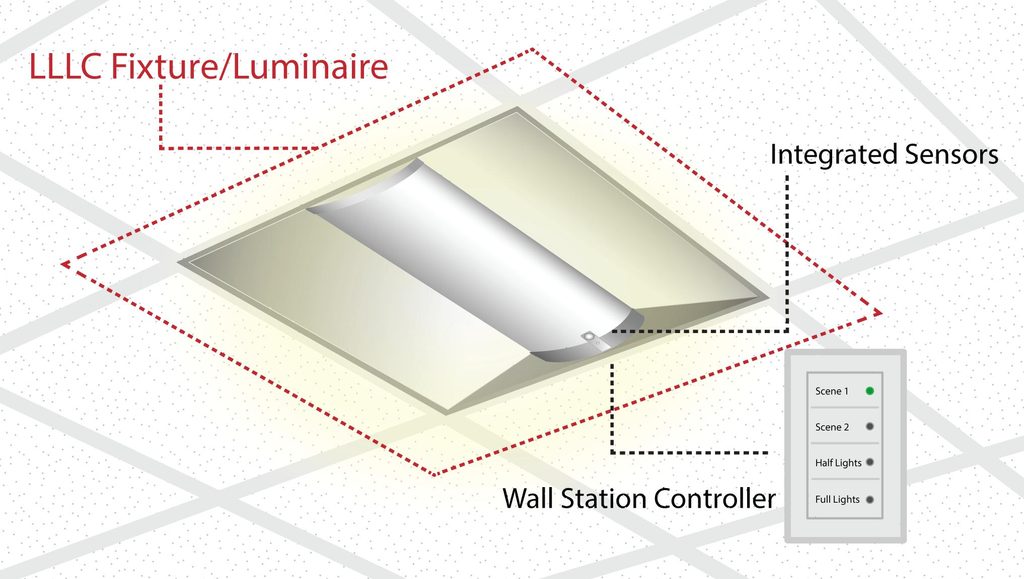
The basic process is simple.
First, the sensors collect information from the space. Next, the local controller processes that information. Finally, the LED driver adjusts the light output.
For example:
Occupancy → Sensor → Controller → LED Driver → Light Output
A network can then connect multiple luminaires.
This allows the lighting system to coordinate different areas of a building.
For example, an office may have separate zones for:
- Open work areas
- Meeting rooms
- Corridors
- Reception areas
- Storage rooms
Each area can use different lighting settings.
Because the luminaires are connected, the system can also support software-based zoning and re-zoning.
Why Is Luminaire-Level Lighting Control Growing?
Several factors are driving interest in LLLC.
1. LED Projects Need Better Controls
LED technology has already improved lighting efficiency. However, efficient fixtures alone do not control when and where light is used.
Controls add another layer of energy management.
For example, an LED fixture can reduce output when a room is empty. It can also respond to daylight.
Therefore, combining efficient LEDs with smart controls can provide more flexible operation.
2. Commercial Buildings Are Becoming More Connected
Modern buildings use more connected systems.
Lighting may now communicate with:
- Occupancy sensors
- HVAC systems
- Building management systems
- Energy monitoring platforms
- Other smart building technologies
The DLC’s NLC V5.2 framework specifically recognizes opportunities for lighting and HVAC integration.
This makes LLLC relevant to broader building automation strategies.
3. Retrofit Projects Need Flexible Solutions
Existing buildings can be difficult to modify.
Installing new control wiring may require changes to ceilings, walls, or electrical infrastructure.
LLLC can provide another approach.
By integrating control components with the luminaire, some projects may reduce the need for separate sensor locations and additional control wiring.
However, the actual installation method depends on the building and system design.
4. Lighting Data Is Becoming More Valuable
Connected lighting can provide more than light.
It can also generate useful data.
Depending on the system, facility teams may monitor:
- Occupancy
- Energy use
- Lighting status
- Device faults
- Operating schedules
- Control settings
This information can help building operators understand how lighting is being used.
As a result, lighting can become part of a larger building data system.
What Are the Benefits of LLLC?
There are several potential benefits.
More Local Control
Each luminaire can respond to conditions near that fixture.
For example, one area can dim while another area remains brighter.
Flexible Zoning
Networked luminaires can support different lighting zones.
Software can also make zone changes easier during a building renovation or layout change.
Occupancy-Based Control
Sensors can detect whether a space is being used.
The system can then adjust the light level based on occupancy settings.
Daylight Response
An ambient light sensor can detect available daylight.
The lighting system can reduce output when enough natural light is available.
Better Energy Management
Smart controls can reduce unnecessary lighting.
However, actual energy savings depend on the building, operating schedule, control strategy, and system configuration.
DLC reported that its analysis of NLC projects found significant energy-saving potential. It also reported higher estimated savings for systems that included LLLC.
LLLC vs Traditional Lighting Controls
The main difference is where the control functions are located.
| Feature | Traditional Controls | Luminaire-Level Lighting Control |
|---|---|---|
| Sensor location | Often separate | Integrated or directly associated with luminaire |
| Local control | Limited by system design | Strong local control |
| Occupancy sensing | Yes | Yes |
| Daylight sensing | Yes | Yes |
| Dimming | Yes | Yes |
| Network connection | Depends on system | Common in LLLC systems |
| Zoning | Possible | Highly flexible |
| Data collection | Depends on system | Can support connected data |
| Retrofit flexibility | Depends on wiring | Can offer more options |
LLLC does not mean every project should replace traditional controls.
The right solution depends on the building, budget, wiring, control requirements, and project goals.
Where Can LLLC Be Used?
LLLC can be used in many commercial applications.
Offices
Open offices can use occupancy sensing and zoning to adjust light levels across different work areas.
Schools
Classrooms can use occupancy and daylight controls to manage lighting during different activities.
Retail Stores
Retail spaces may use different lighting levels for sales areas, storage rooms, and service areas.
Warehouses
Occupancy sensing can help reduce lighting in areas that are not being used.
Hotels
Guest areas, corridors, meeting rooms, and service areas may require different control strategies.
Industrial Buildings
Large spaces can use connected luminaires to create lighting zones and monitor system performance.
Is LLLC Suitable for Every LED Project?
No.
LLLC can provide useful functions, but it also adds technology to the lighting system.
Before selecting an LLLC solution, project teams should review several factors.
Product Compatibility
Check the LED driver, sensor, controller, and network requirements.
Control Protocol
Make sure the system supports the required communication protocol.
Depending on the project, this may include DALI, DALI-2, wireless technologies, or other networked control platforms.
Network Requirements
Wireless and wired systems have different installation requirements.
The project team should understand network coverage, cybersecurity, commissioning, and maintenance needs.
Project Scale
A small office may need a simple control solution.
A large commercial building may require a complete networked system with centralized monitoring.
Future Expansion
Think about future changes.
A flexible system can make it easier to add sensors, change zones, or connect other building systems later.
What Should LED Buyers Ask Suppliers?
If you are buying LED luminaires with LLLC, do not only ask for the fixture price.
Ask the supplier these questions:
- Is the control system integrated into the luminaire?
- Which LED driver is used?
- Is occupancy sensing included?
- Is daylight sensing included?
- What dimming methods are supported?
- Which control protocol is used?
- Is the product compatible with the required network?
- Are technical files available?
- Is the system certified or listed where required?
- What commissioning support is available?
Also ask for complete product documentation.
Useful documents may include:
- Datasheets
- Photometric files
- Driver specifications
- Control information
- Installation instructions
- Certification documents
- Warranty information
Good documentation can reduce problems during specification and installation.
How Does LLLC Connect With HVAC?
One of the most interesting developments is the connection between lighting and HVAC.
An LLLC system can collect occupancy information.
That information may also be useful for HVAC control.
For example, if a zone is empty, the lighting system can reduce light output. At the same time, the building system may adjust the HVAC operation for that zone.
This creates a wider control chain:
Occupancy → Lighting → HVAC → Energy Management
The DLC’s NLC V5.2 update specifically recognizes thermostat integration and external systems integration as part of the wider networked lighting control framework.
This is one reason networked lighting is becoming more important in connected commercial buildings.
Why Is LLLC Important in 2026?
The market is moving from simple LED upgrades toward connected lighting systems.
DLC’s NLC V5.2 took effect on August 17, 2026. The updated requirements strengthen the role of networked controls and recognize opportunities for HVAC integration, configuration reporting, and other connected functions.
There are also signs of stronger adoption.
In a Rhode Island Energy midstream program cited by Inside Lighting, only 4% of linear luminaires sold through the program included LLLC in 2022. By 2026, that figure had reached 75%.
This example does not represent every market. However, it shows how quickly LLLC adoption can change when incentives and project requirements support the technology.
What Is the Future of Luminaire-Level Lighting Control?
LLLC is likely to become part of a broader connected lighting ecosystem.
Future systems may connect:
LED Luminaires + Sensors + Lighting Controls + HVAC + BMS + Energy Data
The focus is also moving beyond simple energy savings.
Connected lighting can provide data that supports space management, maintenance, comfort, and building operations.
At the same time, wireless technologies can provide more flexibility for retrofit projects.
Therefore, LLLC is not just about adding a sensor to an LED fixture.
It is about making the luminaire part of a connected building system.
Conclusion
Luminaire-level lighting control is becoming an important part of modern commercial LED projects.
By integrating sensors and control functions with individual luminaires, LLLC can provide local control, flexible zoning, occupancy sensing, daylight response, and network connectivity.
The technology is also moving closer to HVAC and building management systems.
For LED buyers, the key is to look beyond the fixture itself. Check the driver, sensors, control protocol, network requirements, certification, documentation, and long-term support.
As commercial buildings become more connected, luminaire-level lighting control can give LED projects more flexibility and more options for future upgrades.
FAQ
What does LLLC mean in lighting?
LLLC means Luminaire-Level Lighting Control. It refers to lighting control functions that are integrated into or directly associated with individual luminaires.
What sensors are used in LLLC?
Common sensors include occupancy sensors and ambient light sensors. The exact configuration depends on the lighting system and project requirements.
Is LLLC the same as networked lighting control?
Not exactly. LLLC is a type of lighting control approach in which control components are associated with individual luminaires. Networked lighting controls can include LLLC as well as other system configurations.
Can LLLC reduce energy use?
LLLC can help reduce unnecessary lighting through occupancy sensing, daylight response, dimming, scheduling, and other control strategies. Actual savings depend on the project and system configuration.
Can LLLC connect to HVAC?
Yes. Networked lighting control systems can support external system integration. The DLC’s NLC V5.2 framework recognizes opportunities for lighting and thermostat integration.
Is LLLC good for retrofit projects?
LLLC can be useful for some retrofit projects because integrated control components may provide installation flexibility. However, the existing wiring, network, ceiling, fixture layout, and control requirements should be reviewed first.