
What Are the Main Components of an LED Light?

When purchasing LED lighting, understanding the product structure helps buyers evaluate quality, performance, and cost more effectively. Most LED lights contain four key parts: the housing, LED chips, the driver, and the wiring system.
Each component serves a different purpose. Together, they determine how the fixture produces light, manages heat, receives electrical power, and operates in its intended environment.
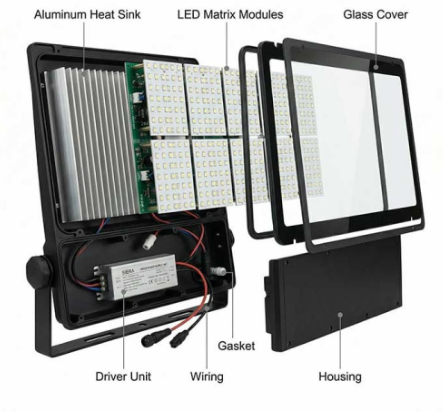
1. Housing: Protection and Heat Dissipation
The housing is the outer structure of an LED light. It protects internal components and helps the fixture maintain its shape and mechanical strength.
Common housing materials include aluminum, plastic, and steel. Aluminum is widely used because it combines relatively low weight with good thermal conductivity. Plastic is often selected for lightweight designs, while steel may be used for structural parts and mounting components.
The housing also plays an important role in heat dissipation. Since excessive heat can affect LED performance and component life, buyers should consider the housing design, material, and cooling structure rather than material alone.
What buyers should check:
- Housing material and construction
- Heat dissipation design
- Corrosion resistance for the intended environment
- Protection against dust and water where required
2. LED Chips: The Light Source
LED chips are the core light-generating components of an LED fixture. When electrical current passes through them, they produce light.
Different LED chips can vary in light output, efficiency, color characteristics, and operating requirements. Their performance also depends on the electrical current, thermal management, and overall fixture design.
For B2B buyers, selecting a suitable LED light means looking beyond the chip name or quantity. The complete fixture’s performance is more useful when comparing products.
What buyers should check:
- Luminous output in lumens
- Luminous efficacy in lm/W
- Color temperature (CCT)
- Color Rendering Index (CRI)
- Light distribution and consistency
These specifications help buyers determine whether a product meets the lighting requirements of a particular project.
3. LED Driver: Power Regulation
The LED driver of LED light components supplies and regulates the electrical power required by the LED chips. It converts the input power into a form suitable for the LED light and helps maintain the required operating conditions.
Driver specifications can affect lighting stability, compatibility, and overall system performance. Therefore, two fixtures with similar appearances and wattages may differ in their driver design and electrical characteristics.
For example, a project requiring dimming needs a driver compatible with the selected dimming method. Similarly, the driver’s input voltage must match the available power supply.
What buyers should check:
- Input voltage range
- Output current and voltage
- Driver efficiency
- Dimming compatibility, if required
- Electrical protection features
- Compatibility with the LED module
A suitable driver is essential to the complete lighting system, so buyers should not evaluate a fixture based on LED chips alone.
4. Wiring and Connections: Safe Power Delivery
The wiring system of LED light components connects the power supply, driver, LED module, and other electrical components. It may include internal wires, connectors, terminals, and grounding connections, depending on the fixture design.
Although wiring is often less visible than the housing or LED chips, it is important for safe and reliable operation. Incorrect connections, unsuitable wire specifications, or poor assembly can cause electrical faults and installation problems.
For outdoor and industrial lighting, wiring and connection design should also suit the installation environment.
What buyers should check:
- Wire and connector specifications
- Secure electrical connections
- Suitable insulation
- Grounding requirements, where applicable
- Protection and sealing at cable entry points
- Compliance with applicable electrical safety requirements
The correct wiring arrangement depends on the product design and the installation requirements.
How Do the Four Components Work Together?
These four components perform different functions, but their performance is closely related.
| Component | Main Function | Key Consideration |
|---|---|---|
| Housing | Protects components and helps manage heat | Material and thermal design |
| LED chips | Generate light | Output, efficiency, and color quality |
| Driver | Regulates electrical power | Compatibility and electrical performance |
| Wiring and connections | Deliver power between components | Connection quality and electrical safety |
For example, efficient LED chips may not deliver the expected performance if the fixture cannot dissipate heat effectively. Likewise, a well-designed housing cannot compensate for an incompatible driver or poor electrical connections.
Therefore, buyers should evaluate the complete fixture rather than focusing on one component in isolation.
Final Thoughts
The housing, LED chips, driver, and wiring system form the core of many LED lighting products. The housing provides protection and supports heat dissipation, the LED chips generate light, the driver regulates power, and the wiring connects the electrical system.
For B2B lighting buyers, understanding these components makes it easier to ask suppliers the right technical questions and compare products based on their actual specifications, construction, and intended applications.