
What is the Real Lifespan of a Commercial LED Panel Light?
Jinbiao Lighting Integrating Sphere Test

Author: Abel | Senior Technical Sourcing & Sales Manager at Shanxi Jinbiao Lighting Co., Ltd.
Published: May 2026
Target Standards: IES LM-80, TM-21, CE, UL, SAA Compliance
In commercial and industrial lighting procurement, managers universally quote “50,000 hours” as the standard lifespan for LED panel lights. For instance, if a standard commercial office operates 10 hours a day, 250 days a year, this numbers theoretically equates to 20 years of maintenance-free operation.
However, optical engineers and commercial electrical contractors frequently encounter a harsh reality. Many budget or generic panels experience critical failure, severe color shifting, or rapid dimming within just 12 to 24 months.
Therefore, to protect your project margins and eliminate post-installation callbacks, we have created this technical guide. Below, we break down the true engineering factors that dictate the longevity of a commercial LED panel light, backed by verified laboratory metrics.
1. The L70 and B50 Metrics: Decoding LED Lifespan
Unlike legacy fluorescent or incandescent bulbs, solid-state LED chips rarely suffer from catastrophic “burnout” unless hit by a massive electrical surge. Instead, they gradually degrade and lose brightness over time.
Furthermore, professional engineers calculate lifespan using two primary industry metrics: L70 and B50.
- L70: This metric defines the point at which the fixture’s light output drops to 70% of its initial lumen output. In addition, 70% represents the industry-accepted threshold where the human eye begins to perceive insufficient office illumination.
- B50: This metric indicates that 50% of the tested batch of fixtures will fall below that 70% lumen maintenance level at the stated hour mark.
Why Do We Rely on LM-80 and TM-21 Testing?
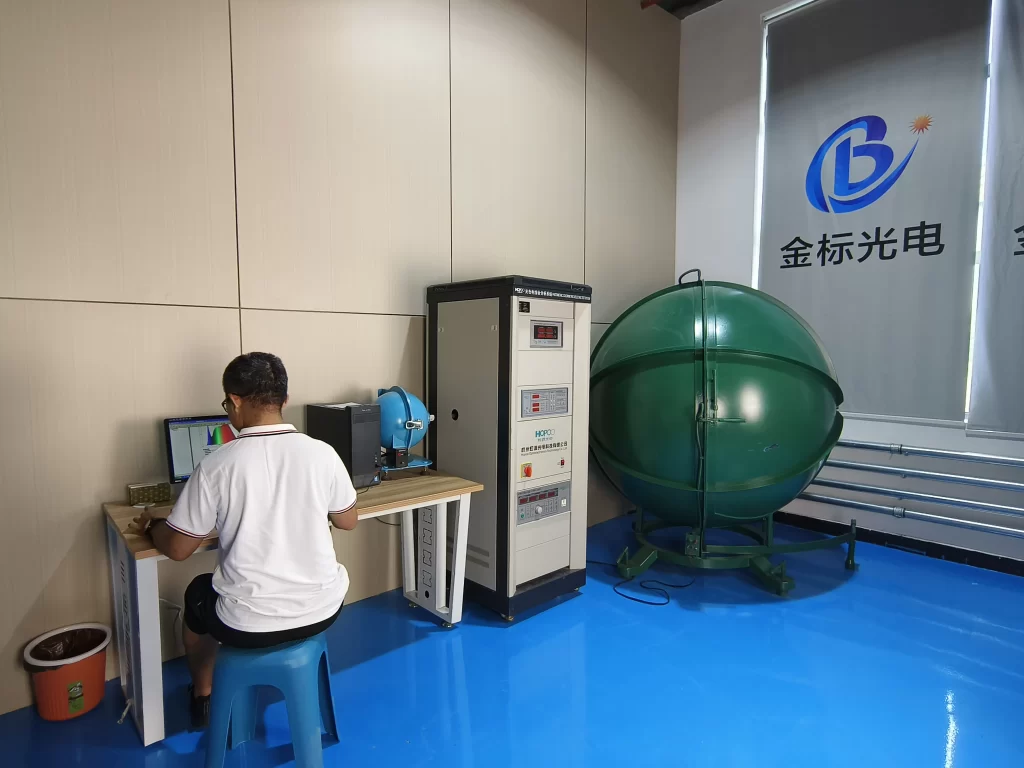
Manufacturers cannot simply guess an honest 50,000-hour claim. Consequently, engineers must mathematically project it. At Shanxi Jinbiao Lighting, our technical team subjects all LED packages to strict IES LM-80 testing. For example, we run the chips continuously at stressed temperatures like 55℃, 85℃, and 105℃ for a minimum of 6,000 to 10,000 hours. Afterward, we apply the IES TM-21 curve-fitting algorithm to project the true L70 lifespan.
Engineering Benchmark: As a result of this rigorous testing, our premium commercial panel series maintains a lumen retention rate of over 96.2% after 6,000 hours of continuous thermal stress. This data projects an actual L70 lifespan well exceeding 54,000 hours.
2. The Three Critical Failure Points Behind Early Degradation
If the LED chips can last 50,000+ hours, why do panels fail early? In most cases, the fault lies within the supporting bill of materials (BOM).
A. Driver Electrolytic Capacitors (The #1 Point of Failure)
The LED driver converts high-voltage AC to constant current DC. Unfortunately, the weakest link inside any driver remains the electrolytic capacitor.
- The Physics of Failure: For every 10℃ increase in the driver’s internal operating temperature, the lifespan of the capacitor’s liquid electrolyte drops by half due to rapid evaporation.
- Cheap, generic drivers use capacitors rated for only 2,000 hours at 85℃. Once the capacitor dries out, the panel begins to flicker violently or fails to power on entirely.
- The Jinbiao Solution: Because we prioritize quality, we equip our commercial panels with premium, certified flicker-free isolation drivers. These components utilize top-tier IC control chips like Lifud or MeanWell architecture. Furthermore, our capacitors carry a rating of 10,000 hours at 105℃, meaning the driver’s lifespan easily matches the LED chips.
B. Thermal Management and Junction Temperature (Tj)
The temperature at the heart of the LED chip itself represents the Junction Temperature (Tj).
- If Tj exceeds 85℃, the internal crystalline structure of the gallium nitride (GaN) semiconductor degrades rapidly. This structural breakdown causes an exponential drop in light output and an irreversible color shift. Consequently, it turns a crisp 4000K office light into an unpleasant dull yellow or blue.
- The Frame Matters: Efficient heat dissipation requires a robust thermal pathway. Nevertheless, budget panels often use ultra-thin plastic or low-grade recycled aluminum backplates.
- The Jinbiao Solution: To combat heat build-up, our manufacturing facility utilizes high-thermal conductivity 6063 aerospace-grade aluminum frames. In addition, we pair this hardware with an automated SMT (Surface Mount Technology) process on high-density aluminum PCBs. This combination reduces thermal resistance and maintains Tj safely below 65℃ in standard commercial drop ceilings.
C. Light Guide Plate (LGP) Material Degradation
In Edge-lit panel lights, the Light Guide Plate (LGP) redirects light evenly across the diffuser. Therefore, your choice of material directly determines whether your ceiling stays bright or turns yellow over time.
| LGP Material Type | Cost | Optical Efficiency / Transparency | Yellowing Resistance (UV & Heat) | Real-world Lifespan Impact |
| PS (Polystyrene) | Low | Moderate (~88%) | Poor (Yellows within 12-18 months) | High lumen drop, bad color shifting. |
| MS (Methyl Methacrylate-Styrene) | Medium | Good (~91%) | Moderate (Stable for 3-4 years) | Acceptable for mid-range retail. |
| PMMA (Acrylic / Virgin Optical Grade) | Premium | Excellent (>93%) | Excellent (No yellowing for 10+ years) | Matches the 50,000h chip longevity. |
Manufacturing Standard: To guarantee the best results, Shanxi Jinbiao Lighting exclusively utilizes pure optical-grade PMMA or premium stable MS for our commercial series. As a result, the light remains crystal clear without any yellowing or structural warping over a decade of use.
3. Our Direct-Factory Quality Assurance Protocol
To guarantee these technical benchmarks before any shipment leaves for international markets like South Africa, Russia, or South America, Shanxi Jinbiao Lighting Co., Ltd. enforces a rigorous, multi-tiered laboratory verification workflow:
- EMC Testing Lab: Our engineers use this facility to ensure that our LED drivers do not create electromagnetic interference with office Wi-Fi networks, hospital equipment, or local communication grids.
- High/Low-Voltage Aging Test Room: Every single batch of panels undergoes a strict 48-hour continuous voltage stress test. During this test, the power safely shifts between 180V and 265V to eliminate early component mortality.
- IES Darkroom Lab: Our team generates official
.IESphotometric data files for every panel series. Therefore, project engineers can accurately simulate lux levels in Dialux software before submitting a project bid.
4. Transparent Warranty and Supply Compliance
We firmly believe that data builds trustworthiness far better than marketing buzzwords. Because of this belief, we back all our commercial-grade LED panel lights with clear protections:
- We provide a legally binding 3-to-5 year replacement warranty specified directly in the commercial contract.
- Our team ensures full regulatory compliance with CE, RoHS, SAA, UL, and ETL standards.
- We offer component-level traceability via unique factory serial numbers.
In conclusion, whether you are an electrical contractor bidding on a high-spec government project, or a wholesale distributor looking to secure a stable supply chain, sourcing direct from an experienced manufacturer is the ultimate way to de-risk your business.
Request Technical Specifications & IES Files: Contact Abel (Sales & Technical Sourcing Manager)
📧 Email: abel.sales@jinbiaolighting.com
📱 WhatsApp / WeChat: +86 17735943005
🌐 Corporate Profile: Shanxi Jinbiao Lighting Co., Ltd.
Click to view the article on LinkedIn.