
How Is AI Changing Lighting Design in 2026?

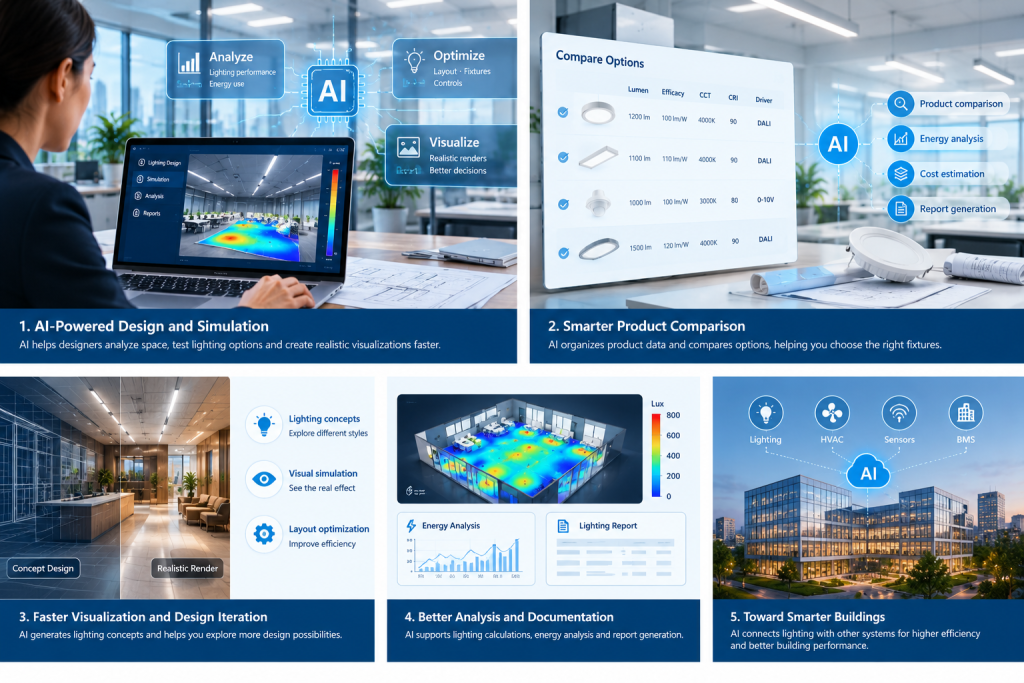
AI lighting design is becoming a practical tool in the lighting industry. In 2026, lighting professionals are using AI to support analysis, compare design options, create documents, and speed up parts of the design process.
AI is not simply about generating a nice lighting image. It can also support technical work. For example, new lighting software is adding AI tools to professional workflows. Industry events are also putting more attention on practical AI applications for lighting designers.
So, how is AI changing lighting design in 2026? More importantly, what does this change mean for LED manufacturers, lighting buyers, and project teams?
What Is AI Lighting Design?
AI lighting design means using artificial intelligence to support parts of the lighting design process.
Traditional lighting design can involve many steps. A designer may need to review a building plan, select luminaires, check light levels, compare products, create simulations, and prepare project documents.
AI can help with some of these tasks.
For example, AI tools may help designers:
- Analyze project information
- Compare lighting options
- Create early design concepts
- Review lighting layouts
- Support photometric analysis
- Generate project documentation
- Visualize different lighting effects
- Identify potential design problems
However, AI does not remove the need for professional lighting knowledge. Human designers still need to check the results and make the final decisions.
Why Is AI Becoming More Important in Lighting?
There are several reasons for the growth of AI in lighting design.
More Complex Lighting Projects
Modern lighting projects are becoming more connected.
A commercial project may include:
- LED luminaires
- Lighting controls
- Occupancy sensors
- Daylight sensors
- DALI systems
- HVAC integration
- Building management systems
- Energy monitoring
As a result, designers need to manage more information.
AI can help organize and compare this information. This can make the early design process more efficient.
Faster Design Changes
Lighting projects often go through many changes.
A client may change the room layout. An architect may move a wall. A project team may change the ceiling design.
Each change can affect the lighting plan.
AI-powered tools can help designers review different options faster. This can reduce some repetitive work during the design process.
More Demand for Energy Efficiency
Energy efficiency is another important factor.
Lighting designers need to consider more than lumen output. They may also need to review controls, occupancy, daylight, operating schedules, and energy use.
AI can help compare different design scenarios.
For example, a designer could compare two lighting layouts based on energy use, light levels, and fixture quantities.
The final result still needs professional review. However, faster comparison can help teams make decisions earlier.
How Can AI Help Lighting Designers?
AI can support several stages of a lighting project.
1. Early Design and Visualization
AI can help create early lighting concepts.
A designer can describe a space and generate different visual ideas. These images can help clients understand the direction of a project before detailed calculations are complete.
For example, a designer may compare:
- Warm and cool lighting
- Direct and indirect lighting
- Different fixture positions
- Different lighting levels
- Different architectural effects
This can make client discussions easier.
However, a visual image is not the same as a photometric calculation. A concept image should not replace technical lighting analysis.
2. Lighting Analysis
AI can also support lighting analysis.
Professional lighting software is moving in this direction. RELUX, for example, now promotes AI tools within its 2026.2 lighting planning software. Its platform continues to focus on lighting calculations, standards, and planning workflows.
This shows an important trend.
AI is moving from general image generation toward more practical lighting workflows.
3. Comparing Lighting Options
Lighting designers often need to compare several solutions.
For example:
Option A: 40W LED panel
Option B: 35W LED panel
Option C: 30W high-efficiency panel
The designer may need to compare:
- Lumens
- Efficacy
- Color temperature
- CRI
- UGR
- Lifetime
- Energy use
- Quantity
- Control compatibility
AI can help organize this information and make comparisons faster.
Still, product data must come from reliable sources. AI should not be trusted to invent missing specifications.
4. Documentation
Lighting projects generate many documents.
These may include:
- Luminaire schedules
- Product lists
- Design notes
- Project summaries
- Control descriptions
- Specification documents
AI can help draft and organize this information.
This is one reason the lighting industry is paying more attention to AI as an assistant rather than a replacement for designers. At ArchLIGHT Summit 2026, one dedicated session focused on using AI for analysis, comparison, and documentation while keeping creative control with the designer.
Can AI Select the Right LED Fixture?
AI can help compare LED fixtures, but product selection still needs human review.
A lighting project may require a specific:
- Beam angle
- Lumen output
- Color temperature
- CRI
- UGR level
- IP rating
- IK rating
- Driver type
- Dimming method
- Control protocol
AI can organize these requirements and compare available products.
However, the designer or buyer should verify the original technical data.
For LED manufacturers, this creates another reason to provide clear product information.
Accurate datasheets, IES files, LDT files, driver information, certifications, and installation instructions can make products easier to evaluate in digital workflows.
How AI Can Help Lighting Buyers
AI is not only useful for lighting designers.
It can also help buyers compare LED products.
For example, a buyer may receive quotations from several suppliers.
Instead of looking only at unit price, the buyer can compare:
| Factor | What to Check |
|---|---|
| Wattage | Actual input power |
| Lumens | Delivered light output |
| Efficacy | Lumens per watt |
| Driver | Brand and performance |
| Lifetime | Rated operating life |
| CRI | Color quality |
| CCT | Color temperature |
| IP Rating | Protection level |
| Dimming | Available control options |
| Certification | Required market compliance |
This approach helps buyers look beyond the lowest price.
For commercial projects, the cheapest fixture may not always have the lowest total cost.
Energy use, maintenance, replacement frequency, controls, and product quality can also affect the project.
AI and Smart Lighting Are Moving Closer Together
AI lighting design is also connected to the growth of smart lighting.
Modern lighting systems can collect more information from:
- Occupancy sensors
- Daylight sensors
- Lighting controls
- Connected LED drivers
- Building management systems
AI can potentially use this data to identify patterns and support better decisions.
For example, a building may have several areas that are rarely occupied. Data analysis could help the facility team review lighting schedules or control settings.
This creates a connection between:
LED Lighting → Lighting Controls → Building Data → AI Analysis
The goal is not simply to make lighting “smarter.”
The goal is to use better data to improve lighting performance and building operation.
What Are the Limits of AI Lighting Design?
AI also has limitations.
First, AI depends on the quality of the information it receives.
If product specifications are incorrect, the result can also be incorrect.
Second, AI-generated images may look realistic but still fail to represent actual light levels.
Third, lighting design involves more than calculations.
Designers must consider:
- Human comfort
- Glare
- Visual quality
- Architecture
- Maintenance
- Safety
- Regulations
- Client requirements
Therefore, AI should support professional decisions rather than replace them.
This practical approach is also reflected in the lighting industry’s recent discussion of AI. ArchLIGHT Summit 2026 presented AI as a tool for lighting designers, with attention on where it adds value and where it falls short.
What Should LED Manufacturers Prepare for?
The growth of AI may also change how LED manufacturers present products.
Traditional product pages often focus on:
- Wattage
- Lumens
- Size
- CCT
- CRI
- IP rating
These specifications are still important.
However, digital lighting workflows may also need more technical files and structured information.
Manufacturers should consider providing:
- Accurate datasheets
- IES files
- LDT files
- Photometric data
- Driver information
- Dimming information
- Control compatibility
- Installation instructions
- Certification documents
Clear product information can make it easier for designers and buyers to evaluate LED products.
It can also reduce misunderstandings during project communication.
What Should Buyers Ask About AI-Ready Lighting?
If you are sourcing LED lighting for a smart project, consider asking suppliers:
- Is the LED driver compatible with the required control system?
- Is photometric data available?
- Are IES or LDT files available?
- Does the product support DALI or other required controls?
- Is dimming supported?
- Can the product work with occupancy sensors?
- Are the technical specifications verified?
- Which certifications are available?
- Can the supplier provide complete product documentation?
- Can the supplier support project testing?
These questions are useful even if the project does not use AI today.
A well-documented lighting product is easier to evaluate, specify, and manage.
What Is the Future of AI Lighting Design?
AI lighting design is likely to become more practical.
The biggest change may not be fully automated lighting design.
Instead, AI may become part of the everyday workflow.
A designer could use AI to:
Analyze → Compare → Simulate → Document → Review
The designer would then make the final decision.
This model combines machine speed with professional experience.
At the same time, lighting software companies are already adding AI functions to professional planning tools. Industry events are also treating AI as a practical design topic rather than only a future concept.
Conclusion
AI lighting design is changing how lighting professionals approach analysis, visualization, comparison, and documentation in 2026.
The technology can reduce repetitive work and help teams explore more options. It can also support better product comparisons and more connected lighting workflows.
However, AI does not replace lighting expertise.
Good lighting still requires accurate data, proper calculations, product knowledge, and professional judgment.
For LED manufacturers and buyers, the message is clear: technical data matters more than ever.
As lighting becomes more digital, products with accurate specifications, reliable photometric files, clear control information, and complete documentation will be easier to evaluate and use in modern lighting projects.
FAQ
Will AI replace lighting designers?
AI can support many parts of the lighting workflow, but current industry discussions focus more on AI as an assistant. Human designers still need to review results and make professional decisions.
What can AI do in lighting design?
AI can help with visualization, analysis, comparison, documentation, and other repetitive tasks. Some professional lighting software is now adding AI tools to existing planning workflows.
Can AI choose LED lights?
AI can help compare LED products based on technical requirements. However, buyers should verify specifications, certifications, photometric data, and control compatibility with the original supplier documents.
Is AI useful for commercial lighting projects?
Yes. AI can help teams compare design options and organize project information. However, final lighting calculations and product selection should still be reviewed by qualified professionals.
Why is AI important for LED manufacturers?
AI-driven workflows increase the value of accurate product information. Manufacturers should provide clear specifications, photometric files, driver information, control compatibility, and certification documents.