
Lumens vs. Watts: The Ultimate Conversion Guide for Commercial LED Lighting Buyers

For decades, when purchasing traditional incandescent or fluorescent lighting, we relied on watts (W) as the primary indicator of brightness. If a bulb used more watts, consumers naturally assumed it was brighter.
However, with the rapid evolution of solid-state technology, watts no longer measure brightness—they measure energy consumption. Today, when sourcing commercial, industrial, or municipal LED fixtures, smart B2B buyers look at lumens (lm). Understanding how to accurately convert and evaluate lumens versus watts is essential for optimizing energy efficiency, meeting project specifications, and cutting operational costs.
In this comprehensive guide, we break down everything you need to know about lumen-to-watt conversion and how to select the right high-efficiency LED solutions for your clients.
1. Defining the Core Metrics: What is the Difference?
Before diving into the conversion math, let’s clarify the definitions:
- Watts (W): The amount of electrical power a light fixture consumes from the power grid. Lower watts mean lower electricity bills.
- Lumens (lm): The total amount of visible light emitted by a source in all directions. More lumens equal a brighter light.
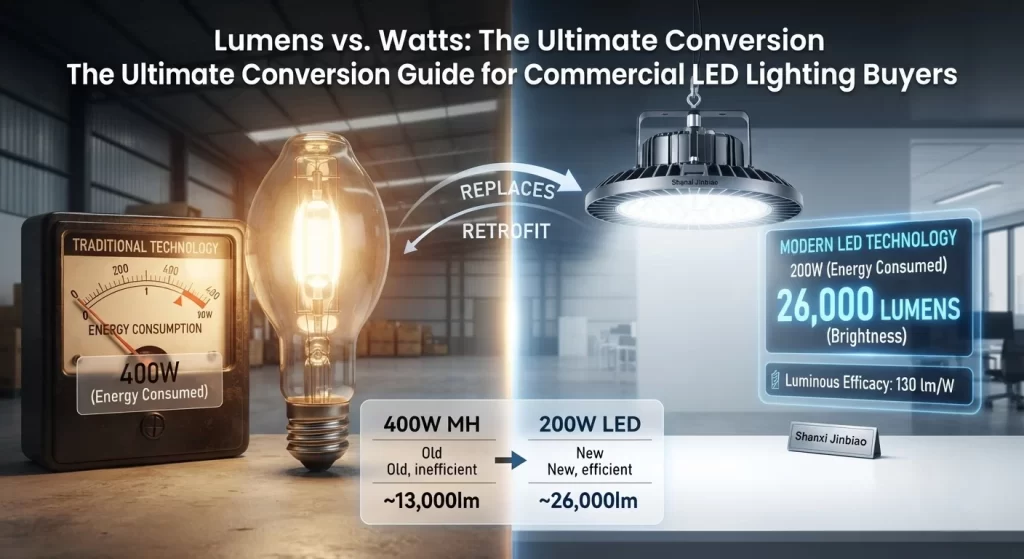
- Luminous Efficacy (lm/W): The ratio of lumens produced per watt consumed. This is the ultimate benchmark of modern LED performance. High-quality commercial LEDs typically achieve an efficacy of 130 to 160 lm/W or higher.
To explore how our advanced engineering delivers ultra-high luminous efficacy across industrial and commercial applications, visit our Product Showcase. Additionally, for broad technical definitions regarding semiconductor lighting efficiency, you can refer to the U.S. Department of Energy (DOE) Solid-State Lighting Program.
2. The Lumen-to-Watt Conversion Cheat Sheet for Commercial Buyers
When retrofitting traditional metal halide (MH), high-pressure sodium (HPS), or fluorescent tubes with modern LEDs, direct wattage comparisons no longer work. Use the following conversion baseline to estimate the required LED wattage for your projects:
| Traditional Source Type | Equivalent Lumen Output | Typical Traditional Wattage | Recommended LED Wattage | Energy Savings |
| Warehouse / High Bay | ~13,000 lm | 250W Metal Halide | 100W LED High Bay | ~60% – 70% |
| Industrial / High Bay | ~26,000 lm | 400W Metal Halide | 200W LED High Bay | ~50% – 60% |
| Outdoor / Street Lighting | ~15,000 lm | 150W HPS | 60W – 80W LED Street Light | ~50% – 60% |
| Office / Linear Lighting | ~3,200 lm | 72W Fluorescent T8 Troffer | 30W LED Panel Light | ~55% – 60% |
For deeper insights into how direct factory manufacturing controls component efficiency and thermal management, read more on our About Us Page. You may also check global electrical equipment compliance insights via the IEC Official Website.
3. Why Luminous Efficacy Matters More Than Raw Wattage
When international engineering firms evaluate tender bids, they don’t just look at total fixture power. They calculate the Total Cost of Ownership (TCO) based on lumen output per watt.
Higher luminous efficacy means fewer fixtures are required to achieve the mandated lux levels (foot-candles) on the work plane, significantly reducing both upfront fixture acquisition costs and long-term electricity consumption.
To ensure global compliance and safety standards, trustworthy manufacturers adhere to testing benchmarks established by international bodies such as the CIE (International Commission on Illumination), which sets the scientific standards for light, color, and lighting metrics. You can also explore photometric testing standards through the IES (Illuminating Engineering Society).
4. Key Factors Beyond Lumens in B2B LED Selection
While lumen-to-watt conversion gives you the baseline brightness and energy profile, professional project procurement requires evaluating three additional pillars:
- Color Rendering Index (CRI): Ensuring accurate color perception (CRI > 80 or > 90 for retail and commercial spaces).
- Color Temperature (CCT): Selecting appropriate Kelvin ratings (e.g., 3000K warm white vs. 5000K daylight) based on the application environment.
- Driver Reliability and Heat Dissipation: Ensuring lumen maintenance (minimizing light decay over 50,000+ operating hours).
Learn more about how we manage quality control, shipping logistics, and custom specifications for global partners by browsing our Blog & Technical Insights Page.
Conclusion
Mastering the conversion between lumens and watts empowers B2B buyers, electrical contractors, and distributors to design superior lighting layouts while maximizing energy savings for end clients. By prioritizing high luminous efficacy and certified manufacturing standards, you ensure long-term project success and client trust.
Looking for high-performance, energy-efficient LED lighting solutions tailored to your market’s exact lumen and voltage requirements? Shanxi Jinbiao Photoelectric Technology Co., Ltd. provides reliable, factory-direct manufacturing backed by rigorous quality control.
👉 Contact Our Lighting Experts Today to request custom photometric data, product catalogs, or competitive wholesale quotes.