
Why Are Lighting Controls Becoming More Important for LED Projects?

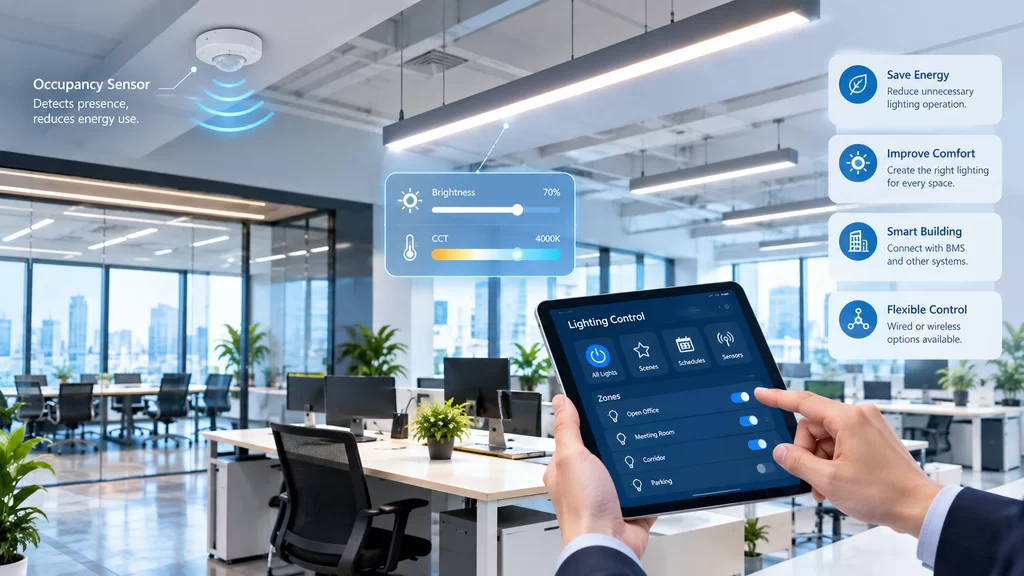
Lighting controls for LED projects are becoming more important as commercial lighting moves toward smarter and more efficient systems.
LED lighting has changed the way commercial buildings use light. LEDs use less energy, last longer, and offer better control than many older lighting technologies.
However, the LED fixture is only part of a modern lighting system.
Today, more projects also use sensors, dimming, timers, wireless control, and smart building systems. As a result, lighting controls are becoming an important part of commercial lighting design.
For buyers, contractors, and project managers, this change creates both opportunities and new questions. Which control system should you choose? Do you need sensors? Should you use wired or wireless control? Can the lighting system connect to a building management system?
This guide explains why lighting controls are becoming more important and what buyers should check before selecting an LED lighting solution.
1. What Are Lighting Controls for LED Projects?
Lighting controls are systems that allow users or building systems to manage lighting.
A basic control can turn a light on or off. More advanced systems can also change brightness, schedule operation, detect movement, measure energy use, and communicate with other building systems.
Common LED lighting control options include:
- Manual switches
- Dimming controls
- Occupancy sensors
- Motion sensors
- Daylight sensors
- Timers
- Remote controls
- Wireless lighting controls
- DALI and DALI-2 systems
- Smart lighting platforms
The right option depends on the building, application, budget, and project goals.
Therefore, lighting control should be considered during the early design stage rather than added at the end.
2. Why Do LED Projects Need Better Lighting Controls?
LEDs already provide high energy efficiency. However, an efficient light can still use energy when nobody needs it.
For example, an office may remain empty for several hours. If all lights stay at full brightness, the building still consumes electricity.
A control system can respond to actual conditions.
For instance, an occupancy sensor can detect whether people are using a space. The system can then turn lights on, reduce brightness, or turn them off when the space is empty.
The U.S. Department of Energy has reported that lighting controls can provide significant energy savings. Recent DOE work also focuses on occupancy-based control and coordination between lighting and HVAC systems.
Therefore, lighting controls can help buildings use the right amount of light at the right time.
3. Energy Efficiency Is More Than LED Wattage
When buyers compare LED products, they often look at wattage and lumens.
These numbers are important. However, they do not tell the whole story.
Imagine two warehouses with the same LED fixtures. One warehouse keeps every light at 100% output all day. The other uses sensors and dimming.
The second building may avoid unnecessary lighting operation.
This is why project efficiency depends on both the lighting equipment and the control strategy.
A good project can combine:
- High-efficiency LED fixtures
- Appropriate lighting levels
- Occupancy detection
- Daylight control
- Dimming
- Scheduling
- Zoning
- Energy monitoring
As a result, buyers should evaluate the complete lighting system instead of comparing fixture prices alone.
4. Occupancy Sensors Can Reduce Unnecessary Lighting
Occupancy control is one of the most practical lighting control strategies.
Sensors detect whether people are using an area. The lighting system can then respond automatically.
For example:
Office: Lights dim when a meeting room is empty.
Warehouse: Lights operate at lower output in unused aisles.
Restroom: Lights turn on when someone enters.
Parking area: Lighting can respond to movement and scheduled operation.
This approach can improve energy management without requiring users to operate switches manually.
In addition, occupancy-based lighting can work with other building systems. The U.S. Department of Energy has also highlighted research into coordinating occupancy-based lighting and HVAC controls.
5. Dimming Gives LED Projects More Flexibility
Not every space needs the same light output all the time.
A conference room may need bright lighting during a presentation. During a video meeting, lower brightness may provide better visual comfort.
Similarly, a retail store may use different lighting levels during different periods.
Dimming allows the system to adjust light output instead of using only full power or no power.
Common dimming methods include:
- 0–10V
- DALI
- DALI-2
- PWM
- Phase-cut dimming
- Digital control systems
However, compatibility matters.
The LED driver, control device, sensor, and control protocol must work together. Therefore, buyers should confirm the complete system before placing a large order.
6. Wireless Lighting Controls Are Becoming More Relevant
Wired control systems remain useful for many projects. However, wireless control can offer more flexibility, especially for retrofit projects.
A wireless system can reduce the need for new control cables. It can also make it easier to add sensors or change the layout later.
The DALI Alliance supports both wired and wireless approaches. Its DALI+ development also supports IP-based and wireless communication, including Thread.
Wireless control can be useful for:
- Existing office buildings
- Retail renovations
- Hotels
- Schools
- Historic buildings
- Flexible office spaces
- Small commercial projects
Nevertheless, wireless is not automatically the best option.
A project should consider building structure, network requirements, installation conditions, cybersecurity, maintenance, and future expansion.
7. Smart Lighting Controls Can Connect With Building Systems
Modern commercial buildings often contain many connected systems.
Lighting can become one part of this larger network.
For example, lighting systems can connect with:
- Building management systems
- HVAC controls
- Occupancy sensors
- Energy management systems
- Smart building platforms
- IoT platforms
This creates new possibilities.
A building can collect information about lighting operation and energy use. Facility managers can then use this information to identify problems or improve building performance.
Modern lighting control design is moving toward zoning, granular control, networked systems, optimization, and building-level data insights.
Therefore, lighting controls for LED projects are increasingly becoming part of a wider building management strategy.
8. Lighting Controls Can Improve User Comfort
Energy savings are important, but they are not the only reason to use lighting controls.
Good control systems can also improve the user experience.
For example, users may need different light levels for:
- Reading
- Computer work
- Meetings
- Retail displays
- Manufacturing
- Warehousing
- Outdoor areas
Some advanced systems also support tunable white lighting. This allows the color temperature and light level to change according to the application or time of day.
Lighting control systems can therefore support both energy goals and the needs of people using the space.
9. Lighting Controls Are Important for Retrofit Projects
Many commercial buildings already have LED fixtures.
Does that mean there is no reason to upgrade the control system?
Not necessarily.
A building may already have efficient LED fixtures but still operate them with basic switches.
In this situation, adding sensors, dimming, scheduling, or wireless controls can provide another layer of efficiency and flexibility.
Wireless solutions can be especially useful for retrofit projects because they may reduce the need for additional control cabling.
For this reason, lighting controls for LED projects should not only be considered for new buildings. They can also be valuable when upgrading existing commercial lighting.
10. What Should LED Lighting Buyers Check?
Before selecting a control system, buyers should check more than the control device itself.
Check LED Driver Compatibility
Ask whether the LED driver supports the required dimming method.
Check Control Protocols
Confirm whether the system uses 0–10V, DALI, DALI-2, DALI+, Bluetooth, Zigbee, or another protocol.
Check Sensor Compatibility
Make sure occupancy and daylight sensors work correctly with the lighting system.
Check Communication
For connected projects, confirm how luminaires communicate with gateways, controllers, and building systems.
Check Future Expansion
Ask whether the system can support additional luminaires, sensors, or control zones later.
Check Installation Requirements
Compare wired and wireless installation requirements before making a decision.
Check Documentation
Request wiring diagrams, driver specifications, control instructions, and commissioning information from the supplier.
11. Wired vs Wireless Lighting Controls
There is no single control method that fits every project.
A simple comparison can help buyers understand the difference.
| Feature | Wired Controls | Wireless Controls |
|---|---|---|
| Installation | Requires control wiring | Less control cabling |
| Retrofit | May require more work | Often more flexible |
| Expansion | Depends on wiring design | Easier to add devices in many cases |
| Reliability | Stable wired connection | Depends on wireless network |
| Flexibility | Good | High |
| Large Projects | Suitable | Suitable with proper planning |
| Existing Buildings | May require additional work | Can simplify some retrofit projects |
The best choice depends on the building and project requirements.
In some cases, a hybrid system can provide a practical solution. Current DALI developments also support combinations of wired, wireless, and IP-based systems.
12. How Lighting Manufacturers Can Support Better Projects
Lighting controls should not be treated as a separate issue from the LED fixture.
Manufacturers can help buyers by providing:
- Compatible LED drivers
- Dimming options
- Sensor-compatible fixtures
- Control specifications
- Wiring diagrams
- Photometric data
- Installation instructions
- Product test reports
- Control system information
- Sample products for testing
A good supplier should also explain which control options are available for each LED product.
For example, a commercial LED panel may support a standard driver, a dimmable driver, or a DALI-compatible driver.
This information helps buyers select the right configuration before production begins.
13. What Should Be Included in the LED Project Specification?
Clear specifications can reduce problems during installation.
Before ordering, buyers should define:
- LED power
- Lumen output
- CCT
- CRI
- Dimming method
- Driver type
- Control protocol
- Sensor requirements
- Communication method
- Emergency lighting requirements
- Installation method
- Warranty
- Required certifications
In addition, the approved sample should match the final production specification.
This step is especially important for large commercial projects.
14. Why Are Lighting Controls More Important in 2026?
The lighting industry is moving from standalone fixtures toward connected systems.
Recent industry activity supports this direction. Light + Building 2026 highlighted wireless and interoperable lighting control. DALI+ with Thread was also presented as a way to support standardized, IP-enabled wireless communication.
At the same time, modern lighting control design is becoming more sophisticated. Control is moving beyond simple room-level switching toward more granular, networked, and data-driven systems.
For buyers, this means one thing:
The question is no longer only “Which LED light should we buy?”
It is also:
“How should these LED lights operate?”
That is why lighting controls for LED projects are becoming an increasingly important part of commercial lighting specifications.
LED Lighting Control Checklist
Before ordering LED lighting for a commercial project, ask:
- Does the project need dimming?
- Are occupancy sensors required?
- Is daylight control useful?
- Should the lighting connect to a building management system?
- Will the project use wired or wireless controls?
- Are the LED drivers compatible?
- Is DALI or another protocol required?
- Can the system be expanded later?
- Has the control system been tested with the selected LED fixtures?
- Does the supplier provide complete technical documentation?
Final Thoughts
LED technology provides the foundation for energy-efficient lighting. However, the right control strategy can make a lighting system more flexible, efficient, and easier to manage.
For new buildings, lighting controls should be considered during the design stage. For retrofit projects, wireless controls and smart sensors can provide additional flexibility.
Most importantly, buyers should look at the complete system. The LED fixture, driver, sensor, controller, communication protocol, and software should work together.
If you are sourcing LED lighting for commercial projects, choose a supplier that can provide reliable LED products and clear technical information about control options.
At Jinbiao Lighting, we focus on LED lighting solutions for commercial and project applications. Contact us to discuss LED fixtures, drivers, dimming options, and lighting solutions for your next project.