
High CRI vs Low CRI LED Lighting: What’s the Difference?

When choosing LED lighting, CRI (Color Rendering Index) is an important specification to consider. It affects how accurately a light source shows the colors of objects and surfaces.
For B2B lighting buyers, the key question is often simple: Do you need high CRI or is standard CRI enough?
The answer depends mainly on the application, visual requirements, and project budget.
What Is CRI?
CRI measures how accurately a light source reveals colors compared with a reference light source. The scale generally ranges from 0 to 100.
A higher CRI usually means that colors appear more natural and accurate. However, that does not mean every project needs the highest possible CRI.
In practice, buyers can generally divide LED lighting into lower-CRI options for general lighting and high-CRI options for applications where color accuracy matters.
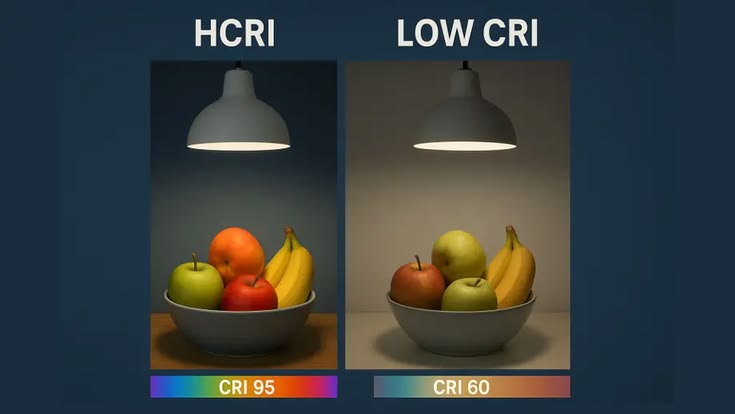
Low CRI LED Lighting
Low or standard CRI LED lighting focuses more on practical illumination, efficiency, and cost than precise color reproduction.
For many general-purpose projects, standard CRI provides sufficient visual performance. Therefore, buyers do not always need to pay extra for high-CRI products.
Typical Applications
Standard or lower-CRI LED lighting can work well in:
- Warehouses
- Parking areas
- Corridors
- Industrial facilities
- Utility rooms
- General offices
- Outdoor areas
- Storage spaces
These environments mainly require reliable and effective illumination. Accurate product or material color is usually less important.
High CRI LED Lighting
High CRI LED lighting provides better color rendering and helps objects appear more natural under artificial light.
As a result, high-CRI products are particularly useful when customers need to evaluate colors, materials, products, or finishes accurately.
Typical Applications
High-CRI LED lighting is often suitable for:
- Retail stores
- Showrooms
- Hotels
- Restaurants
- Museums
- Art galleries
- Cosmetic stores
- Photography studios
- Premium residential spaces
For example, a retail store may need high CRI lighting to present clothing, furniture, food, or other products more accurately.
High CRI vs Low CRI: Key Differences
| Feature | Low / Standard CRI | High CRI |
|---|---|---|
| Color accuracy | Standard | Higher |
| General illumination | Excellent | Excellent |
| Product display | Limited | Better |
| Visual color evaluation | Basic | More accurate |
| Typical cost | More budget-friendly | Usually higher |
| Common applications | Warehouses, offices, industrial areas | Retail, showrooms, hotels, galleries |
The right choice depends on the project rather than simply choosing the highest CRI available.
Which CRI Should You Choose?
Start with the purpose of the lighting.
If the project mainly requires general illumination, standard CRI can provide a practical and cost-effective solution.
If the project involves product presentation, interior design, color matching, or visual evaluation, high CRI is usually a better choice.
For example:
Warehouse → Standard CRI
Office → Standard CRI
Retail Store → High CRI
Showroom → High CRI
Art Gallery → High CRI
This approach helps buyers avoid paying for specifications that the project does not actually require.
CRI Is Not the Only Factor
Although CRI affects color appearance, buyers should not evaluate an LED light by CRI alone.
Other specifications also influence overall lighting performance:
- Lumens: Total light output
- lm/W: Energy efficiency
- CCT: Light color, such as 3000K, 4000K, or 6000K
- Beam Angle: Light distribution
- IP Rating: Protection against dust and water
- Input Voltage: Electrical compatibility
- Dimming: Brightness control capability
Therefore, the best lighting solution balances CRI with the complete project requirements.
Final Thoughts
The main difference between high CRI and low CRI LED lighting is color rendering performance.
Standard CRI works well for many general lighting applications where accurate color reproduction is not critical. On the other hand, high CRI is a better choice for retail, hospitality, showrooms, galleries, and other spaces where color appearance directly affects the customer experience.
For B2B buyers, the best approach is not simply to choose the highest CRI. Instead, match the CRI level to the application and then compare the other key specifications to find the right overall lighting solution.