
How to Reduce LED Lighting Quality Risks?

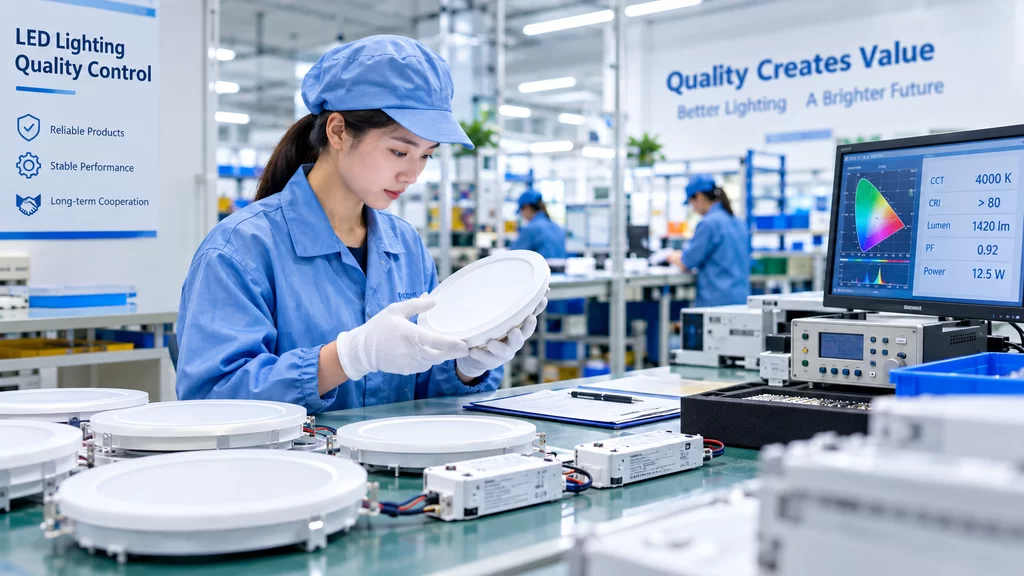
Buying LED lighting from China can offer competitive prices and many product choices, but it can also create LED lighting quality risks if you choose the wrong supplier.
Poor quality may lead to product returns, warranty claims, project delays, and customer complaints. Therefore, buyers should control quality before placing a large order.
The good news is that you can reduce many risks with a clear buying process. First, check the supplier. Then, test the product. Finally, control quality during production and before shipment.
This guide explains how to reduce LED lighting quality risks when sourcing from China.
1. Choose the Right LED Lighting Supplier
Supplier selection is the first step in quality control.
Before you place an order, learn more about the company. For example, look at its factory, product range, export experience, and quality system.
Important points include:
- Company background
- Factory location
- Main product range
- Production capabilities
- Export experience
- Quality control process
- Certifications
- Test equipment
- After-sales service
In addition, ask whether the company owns its factory or works with outside manufacturers.
A live factory video call can also help. You can see the production line, testing area, warehouse, and finished products.
Most importantly, do not judge a supplier only by its website or catalog.
2. Confirm the LED Lighting Specifications
Clear product specifications can prevent many quality problems.
Before ordering, make sure the supplier provides complete technical data. The specification should cover the main parts of the product.
For LED lighting, check:
- Input voltage
- Power
- Lumens
- Luminous efficacy
- CCT
- CRI
- Beam angle
- Power factor
- IP rating
- Dimming method
- LED chip
- LED driver
- Housing material
- Working temperature
- Warranty period
For example, do not accept a description such as “high brightness.”
Instead, ask for clear data such as:
100W, 14,000 lm, 140 lm/W, 4000K, CRI ≥80
As a result, both sides have the same product target. This also makes sample testing easier.
3. Pay Attention to the LED Driver
The LED driver is a key part of many LED luminaires.
A poor driver can cause several problems. These may include:
- Flickering
- Unstable light output
- Overheating
- Poor power factor
- Dimming problems
- Early product failure
Therefore, ask the supplier for the exact driver model.
You should also ask:
- Who makes the driver?
- What is the input voltage?
- What is the power factor?
- Is surge protection included?
- What is the working temperature?
- Is the driver suitable for the product?
- Can the driver be changed during production?
For larger projects, keep the approved driver model in your product specification.
That way, the factory cannot replace it with a lower-cost model without your approval.
4. Check the LED Chips and Main Components
LED chips affect light output, color consistency, and efficiency. However, other components are also important.
For example, check the:
- LED PCB
- LED driver
- Heat sink
- Optical lens
- Housing
- Connectors
- Wires
- Gaskets
- Screws
- Surge protection parts
For important projects, ask for a clear BOM, or Bill of Materials.
The BOM helps you understand what goes into the product. More importantly, it gives you a reference for future orders.
If a key component needs to change, ask the supplier to inform you first.
5. Test Samples Before Bulk Production
Sample testing is one of the easiest ways to reduce quality risks.
Do not place a large order based only on product photos. Instead, request samples and test them before mass production.
During testing, look at three main areas.
Electrical Performance
Check:
- Input power
- Voltage
- Current
- Power factor
- Flicker, when required
Lighting Performance
Measure:
- Lumens
- CCT
- CRI
- Beam angle
- Light distribution
Physical Quality
Inspect:
- Housing
- PCB
- Wiring
- Screws
- Connectors
- Heat sink
- Surface finish
- Installation parts
In addition, run the product for a suitable period. Check whether the housing or driver becomes too hot.
One sample can show product quality. Several samples can give you a better view of production consistency.
6. Approve a Golden Sample
After testing, keep one approved sample as your golden sample.
This sample becomes the quality reference for mass production.
Record important details such as:
- Product model
- Power
- Lumens
- CCT
- CRI
- Driver model
- LED chip
- Housing
- Dimensions
- Color
- Accessories
- Packaging
Then, make sure the supplier understands one important rule:
Mass production should match the approved sample and specification.
This simple step can reduce misunderstandings between buyers and factories.
7. Review the Factory QC Process
A reliable LED lighting factory should have a clear quality control process.
First, the factory should inspect incoming materials. Next, workers should check products during assembly. After that, finished products should go through suitable tests.
A typical process may look like this:
Incoming Inspection → Production Inspection → Aging Test → Performance Test → Final Inspection → Packing
Depending on the product, the factory may also check:
- Electrical safety
- Light output
- CCT
- CRI
- Power
- Driver performance
- Temperature
- Appearance
- Packaging
Furthermore, ask what testing equipment the factory uses.
For example, an integrating sphere can help measure important lighting data. Electrical test equipment can also help check product performance.
8. Check Test Reports and Certifications
Certificates are useful, but they do not prove everything about product quality.
For this reason, ask for the actual test reports and technical documents.
Depending on the product and target market, these may include:
- CE documents
- RoHS documents
- EMC test reports
- Electrical safety reports
- Photometric reports
- LM-80 documents, where applicable
- TM-21 calculations, where applicable
- IES files
- LDT files
- Energy-related documents, where required
Most importantly, check whether the documents match your actual product.
For example, a report for Model A should not be used for Model B.
Also, check the product model, specifications, manufacturer, and test date.
9. Verify the Factory Before a Large Order
For a large order, factory verification can reduce supply risks.
You can choose different methods based on your order size.
For example:
- Video factory audit
- Online factory tour
- On-site factory audit
- Third-party inspection
During a factory audit, look beyond the showroom.
Instead, pay attention to:
- Production lines
- SMT equipment
- Assembly areas
- Aging test area
- Testing laboratory
- Raw material warehouse
- Finished goods warehouse
- QC records
- Production capacity
As a result, you can better understand whether the supplier can support your long-term orders.
10. Control Quality During Mass Production
Quality control should not stop after sample approval.
Production conditions can change. For instance, a supplier may change a driver, PCB, LED chip, or other component.
Therefore, keep the approved product specification on file.
You should also ask the supplier to inform you before changing important components.
For repeat orders, production inspections can provide another layer of protection. They help you find problems before the goods leave China.
11. Arrange a Pre-Shipment Inspection
A pre-shipment inspection, or PSI, is useful for larger orders.
The inspection usually takes place when most of the goods are ready.
An inspector can check:
- Product quantity
- Product appearance
- Dimensions
- Labels
- Packaging
- Accessories
- Product specifications
- Electrical performance
- Random samples
For higher-risk orders, you may also use a third-party inspection company.
Most importantly, inspect the products before shipment when possible.
It is usually easier to solve a quality problem in China than after the goods arrive at your warehouse.
12. Check the Packaging
Good LED products can still be damaged during transportation.
Therefore, packaging should also be part of your quality plan.
Check:
- Individual product packaging
- Inner boxes
- Carton strength
- Protective materials
- Carton quantity
- Carton dimensions
- Shipping marks
- Product labels
For fragile products, ask the supplier how the packaging protects the product during transport.
In addition, make sure the mass-production packaging matches the approved sample.
13. Put Quality Requirements in Writing
Verbal promises can cause problems later.
Instead, put important requirements into your quotation, purchase order, or technical specification.
For example:
Power: 100W
CCT: 4000K
CRI: ≥80
Luminous efficacy: ≥140 lm/W
IP rating: IP66
Driver: Approved model
Warranty: 5 years
You can also define acceptable tolerances when needed.
This gives both the buyer and supplier a clear reference.
As a result, it becomes easier to check whether the final product meets the agreed requirements.
14. Do Not Compare Suppliers by Price Alone
Price is important for every B2B buyer. However, the lowest quotation may not always provide the lowest total cost.
A poor-quality product can create extra expenses, such as:
- Replacement products
- Warranty claims
- Return shipping
- Customer complaints
- Project delays
- Installation costs
- Lost sales
Therefore, compare the complete offer.
Look at:
- Product specifications
- LED chips
- Driver
- Testing
- Certifications
- Warranty
- Packaging
- Lead time
- After-sales service
In other words, ask:
“What am I getting for this price?”
This approach helps buyers compare the real value of different LED lighting suppliers.
LED Lighting Quality Risk Checklist
Before placing a large order, use this checklist:
| Checkpoint | What to Confirm |
|---|---|
| Supplier | Company and factory information |
| Product | Complete technical specifications |
| LED chip | Brand, model, and consistency |
| Driver | Model, brand, and specifications |
| Sample | Tested and approved |
| Golden sample | Kept as production reference |
| BOM | Important components confirmed |
| Certifications | Documents match the product |
| Testing | Photometric and electrical data |
| QC | Factory inspection process |
| Production | Quality monitored during production |
| PSI | Pre-shipment inspection |
| Packaging | Approved and protected |
| Warranty | Terms clearly defined |
| Changes | Supplier must notify buyer |
Final Thoughts
Reducing quality risks when buying LED lighting from China starts before you place the order.
First, verify the supplier. Then, confirm the product specifications and components. After that, test the samples and approve a golden sample.
During production, keep quality requirements clear. Finally, inspect the finished products before shipment.
In this way, buyers can reduce avoidable quality problems and build a more reliable supply chain.
If you are looking for an LED lighting manufacturer in China, Shanxi Jinbiao Lighting provides LED lighting solutions for distributors, wholesalers, importers, and commercial projects.
Contact us to discuss your product requirements, samples, specifications, and OEM/ODM needs.